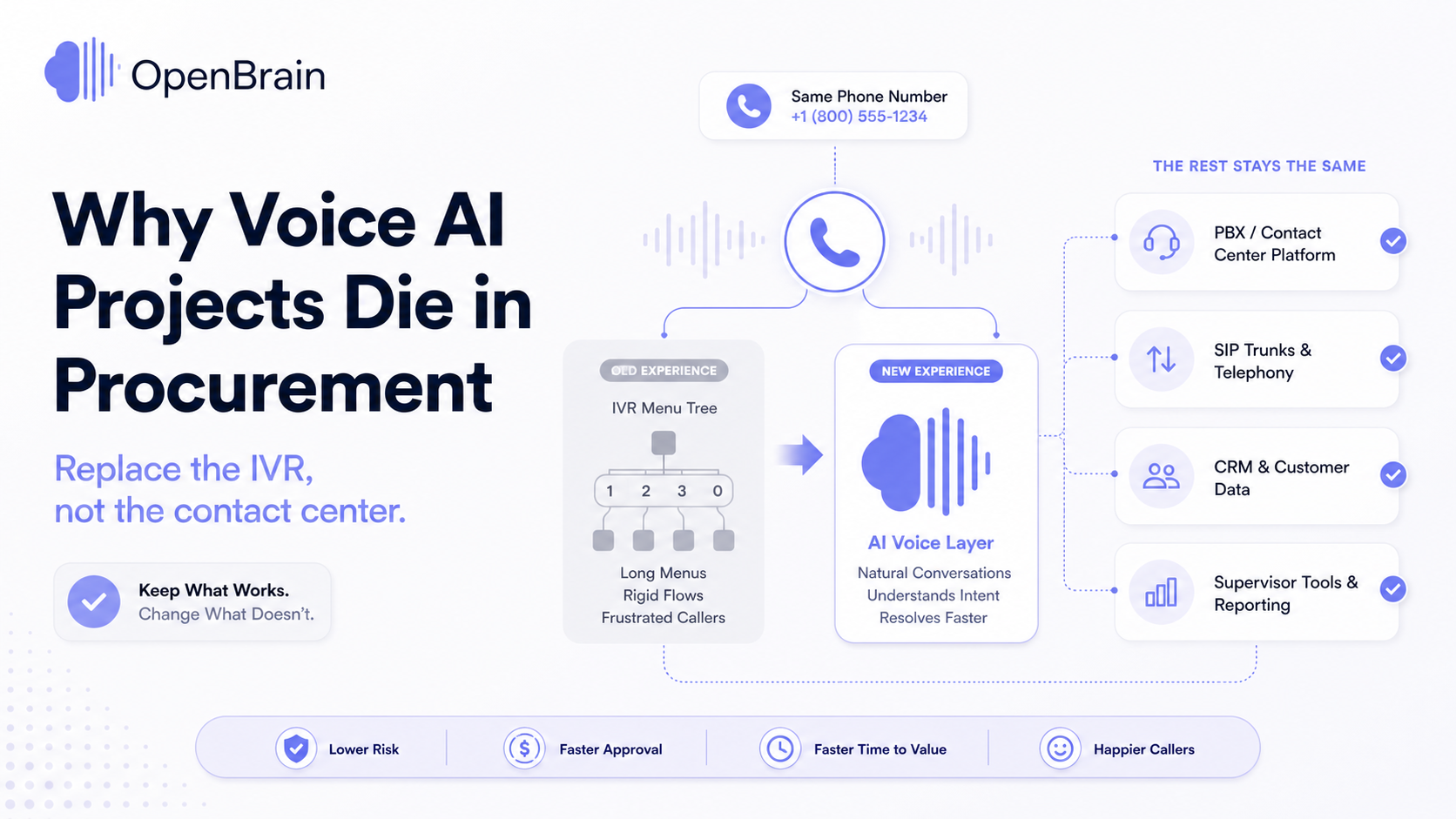
There’s a meeting that happens in every contact center modernization cycle. We’ve sat in this meeting more times than we want to count, and so has anyone who’s tried to ship voice AI into a regulated enterprise environment.
It’s the meeting where the CFO sees the migration cost. The CTO sees the integration risk. Procurement sees a long-month timeline. Someone in the room says, “maybe next year.” The project dies.
The frustrating part is that the technology has usually been ready for a while. What hasn’t been ready is the framing.
This post is for the people who’ve sat in that meeting – and for the vendors who’ve watched their pilot get killed in it. We want to argue that the problem isn’t technological maturity, isn’t budget, isn’t even risk appetite. The problem is what voice AI vendors keep asking enterprise buyers to do.
The ask that doesn’t survive
Every voice AI vendor walked into procurement asking for some version of the same thing.
Replace your IVR. Replace your call routing logic. Replace your numbers. Replace your SIP trunks. Replace your reporting integration. Migrate your CRM connectors. Retrain your supervisor team on a new console. Move your data into our cloud. Sign a multi-year commit on the new platform before you’ve seen it run.
Stack those asks together and you have a 14-month migration project with seven-figure switching costs and meaningful business risk if anything goes wrong. The CFO is right to flinch. The CTO is right to flag the integration risk. Procurement is right to ask why the timeline is so long.
This isn’t a vendor problem. It’s an architectural problem. The voice AI products that came out of the 2023–2024 funding cycle were built as full contact center platforms, not meant to augment it. That made sense from a venture economics perspective. It didn’t make sense from a buyer’s perspective.
The buyer’s actual pain isn’t the contact center as a whole. The contact center mostly works. The phone numbers work. The routing works. The trunks work. The supervisor consoles work. Customers know how to reach the company. Agents know how to do their jobs.
What doesn’t work is the menu tree at the front. The “press 1 for billing” that customers hate. The 90-second hold music. The agents drowning in tier-1 calls a bot could close in seconds. The after-hours coverage gap. The friction every customer encounters before they reach the part of the system that actually works.
That’s a much smaller surface to change. And it’s the only surface that needs to change.
What rips out, and what stays
Here’s the thought experiment that reframes the procurement conversation. Forget any voice AI product for a moment, including ours. Just look at your contact center as it stands today. Make a list of what works and what doesn’t.
What works (in most enterprise deployments we’ve seen):
- The PBX or contact center platform itself, whether it’s an Avaya, Genesys, NICE, Cisco, or cloud-native equivalent. It handles call routing, supervisor functions, recording, reporting integrations, and the operational workflows your team has built around it over years.
- The SIP trunk and number ranges. Customers know your numbers. Marketing has them printed on materials going back a decade. Your billing system has them tied to outbound campaigns. They have to stay.
- The downstream integrations. CRM, ticketing, billing, knowledge bases, agent desktop tools. Every one of these has been integrated, tested, and operationalized. Replacing any of them is its own multi-quarter project.
- The supervisor console workflow. Your CX leadership team has built dashboards, KPI reports, agent coaching cycles, and quality assurance processes around a specific operational rhythm. Disrupting that costs more than any voice AI saves.
What doesn’t work:
- The IVR menu tree. Even the best-designed IVRs are universally disliked by customers. Self-service rates are low. Misrouting is common. Updates take weeks because every change touches a brittle XML or proprietary script.
- The deflection rate. Most contact centers deflect 10–20% of inbound volume into self-service, and the cost-per-call for the rest stays high. The cheapest calls — balance inquiries, appointment confirmations, simple status checks, basic policy questions — eat the same agent capacity as the complex ones.
- After-hours coverage. Most service businesses either don’t offer it, offer it in a degraded form, or pay overnight premiums for skeleton staffing.
- Multilingual handling. If your customers speak more than one language, you’re either staffing for it (expensive) or losing those callers at the front door (also expensive, just hidden).
- The triage workload. In healthcare, clinical staff spend a meaningful fraction of their time doing telephone intake. In financial services, senior agents handle volumes of routine inquiries. In telecom, churn-prevention teams spend most of their time confirming what customers already know about their plans.
Now look at the two lists. The “works” list is everything most voice AI vendors are asking you to migrate or replace. The “doesn’t work” list is the actual surface area that needs to change. They barely overlap.
The procurement meeting where modernization projects die is the meeting where someone notices this. The CFO is being asked to fund a migration of things that work. The CTO is being asked to take integration risk on workflows that aren’t broken. The decision is rational. The project should die.
What changes when nothing has to be replaced
OpenBrain is built on a different premise. Don’t replace what works. Replace only what doesn’t.
The architecture sits between your existing telephony and your AI capabilities, not in front of either. We connect to your PBX over standard SIP. Your phone numbers stay. Your routing logic stays. Your trunks stay. Your CRM and ticketing integrations stay. Your supervisor consoles stay. We publish a parallel supervision panel for the AI conversations that mirrors the workflows your team already knows.
What we replace: the IVR menu. The hold-music wall. The “all our agents are currently busy” message. The after-hours voicemail tree. The first-line triage that consumes expensive human time on calls that shouldn’t need it.
What customers experience: they call the same number they’ve always called. Instead of a menu tree, they hear a voice that asks what they need, in their own language. The AI either resolves the call end-to-end or routes to a human agent with the customer’s intent and context already on the agent’s screen. The customer never knows the bot was the first responder. The agent doesn’t have to start from “hello, how can I help you.”
What the procurement meeting looks like: instead of a 14-month migration with seven-figure switching costs, the conversation is about a focused deployment that touches only the IVR layer, integrates over standard protocols, runs in your data center if you need it to, and can be piloted on a single phone number before any wider rollout. The CFO can model the ROI on a single use case. The CTO can review the integration on a single SIP endpoint. Procurement sees a scope they can underwrite.
That’s the version of voice AI that survives procurement.
The trade-offs we made
This architecture is a deliberate trade-off, and it’s worth being honest about what we gave up to get there.
We gave up the ability to redesign the entire customer journey from scratch. If your contact center fundamentals are broken (wrong routing, wrong workforce model, wrong KPIs) OpenBrain won’t fix them. We sit on top of your operational layer. We make the front door of the phone system intelligent; we don’t redesign the building.
We gave up some of the upside available to “rip and replace” platforms. A vendor that controls the entire stack can optimize across layers we don’t touch. We chose not to control those layers because controlling them would make the deployment unpalatable.
We gave up vendor lock-in as a business model. OpenBrain is replaceable. If something better comes along in three years, you can swap us out without re-migrating your contact center. We think this is a feature, not a bug, but it does mean we have to keep earning the renewal every year.
In exchange, we got something most voice AI vendors don’t have: a deployment model that survives procurement.